

On 10 March 1855, Sultan Ali Iskandar Shah, the last of the Bendahara rulers, peacefully ceded Johor to the Temenggong through the State of Johor Treaty of Friendship and Alliance and payment of compensation.
The Transition of Authority From The Bendaharas to The Temenggong
Early History
Although the Temenggong gained ownership and sovereignty of Johor, he did not use the title "Sultan" in deference to Sultan Ali Iskandar Shah, who was made the Sultan of Kesang.
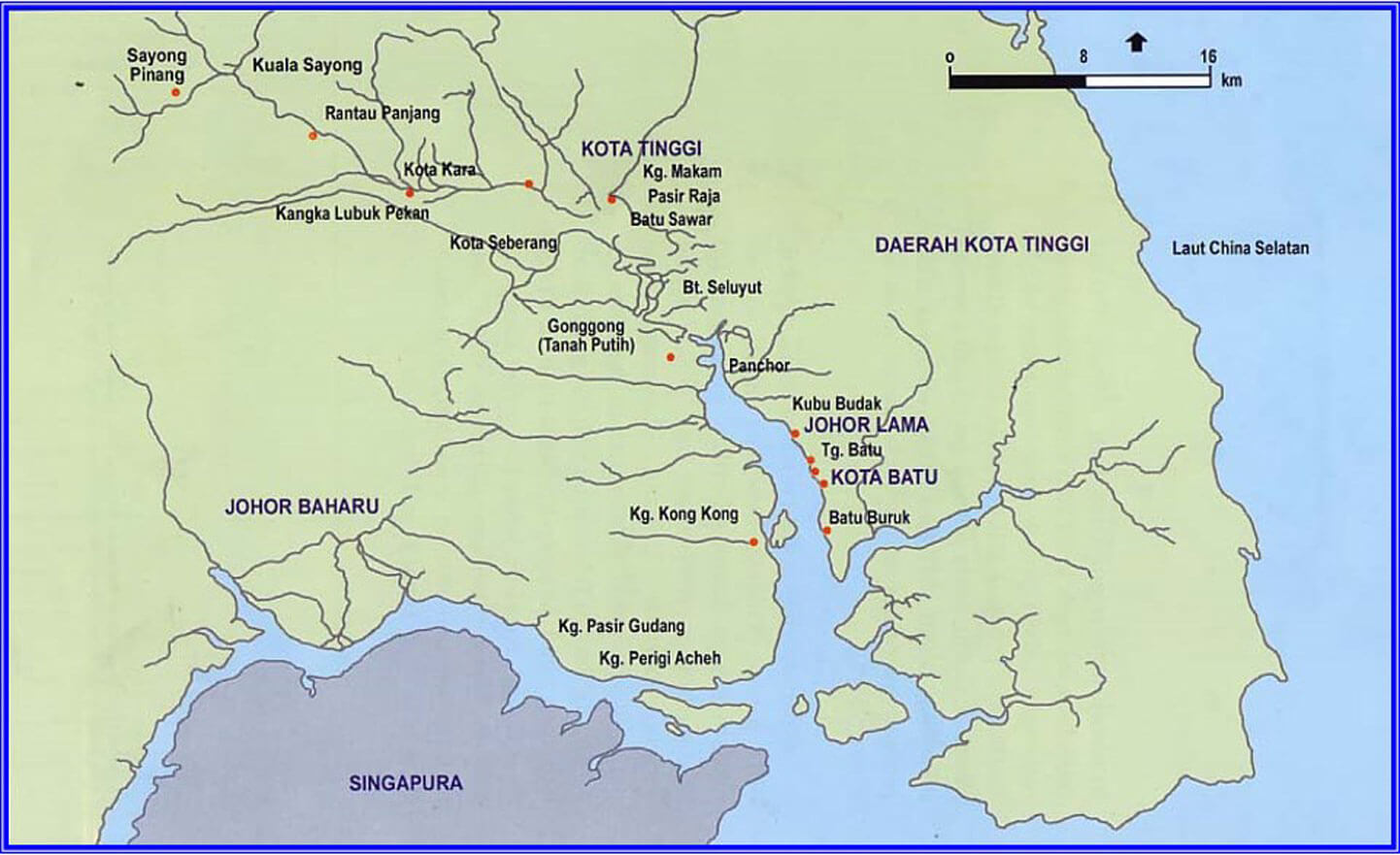
The administrative Center of the Old Johor Kingdom in Sungai Johor. (Source: N.A.Halim, 1990. Malay Cities)
Only after the cessation of the province of Kesang by the heirs of Sultan Ali in 1877 to Johor did the Maharaja of Johor began to take action in changing his title to Sultan for two reasons:
- Firstly: the Malay rulers of other states refused to recognize him as, in their opinion, he was not of royal blood. However, his ancestry proved he was of royal blood, descended from Bendahara Tun Habab.
- Secondly: the title Sultan would place him at the same status, if not above the other Malay rulers, and who would possess higher authority than the British or any foreign power.
The British were apprehensive of Abu Bakar, who was charismatic, intelligent and influential in interstate relations. However, his recognition as Sultan and Sovereign Ruler of Johor in 1885 not only fulfilled his ambition and confirmed his legitimacy and status as Sultan but also provided the impetus for the development of Johor.
Treaties And Agreements
Treaty Between The Sultan Of Johor And The Temenggong Ceding Full Sovereignty To The Temenggong The Whole Territory Of Johor With The Exception Of Kesang
A treaty of Friendship and Alliance between His Highness Sultan Ali Iskandar Shah bin Sultan Hussain Mohamad Shah and His Highness Dato' Temenggong Daeng Ibrahim bin Abdul Rahman Sri Maharaja, signed on 10 March 1855 in Singapore witnessed by W.J. Butterworth, Governor of the Straits Settlements, and T. Church Resident Councillor, Singapore.
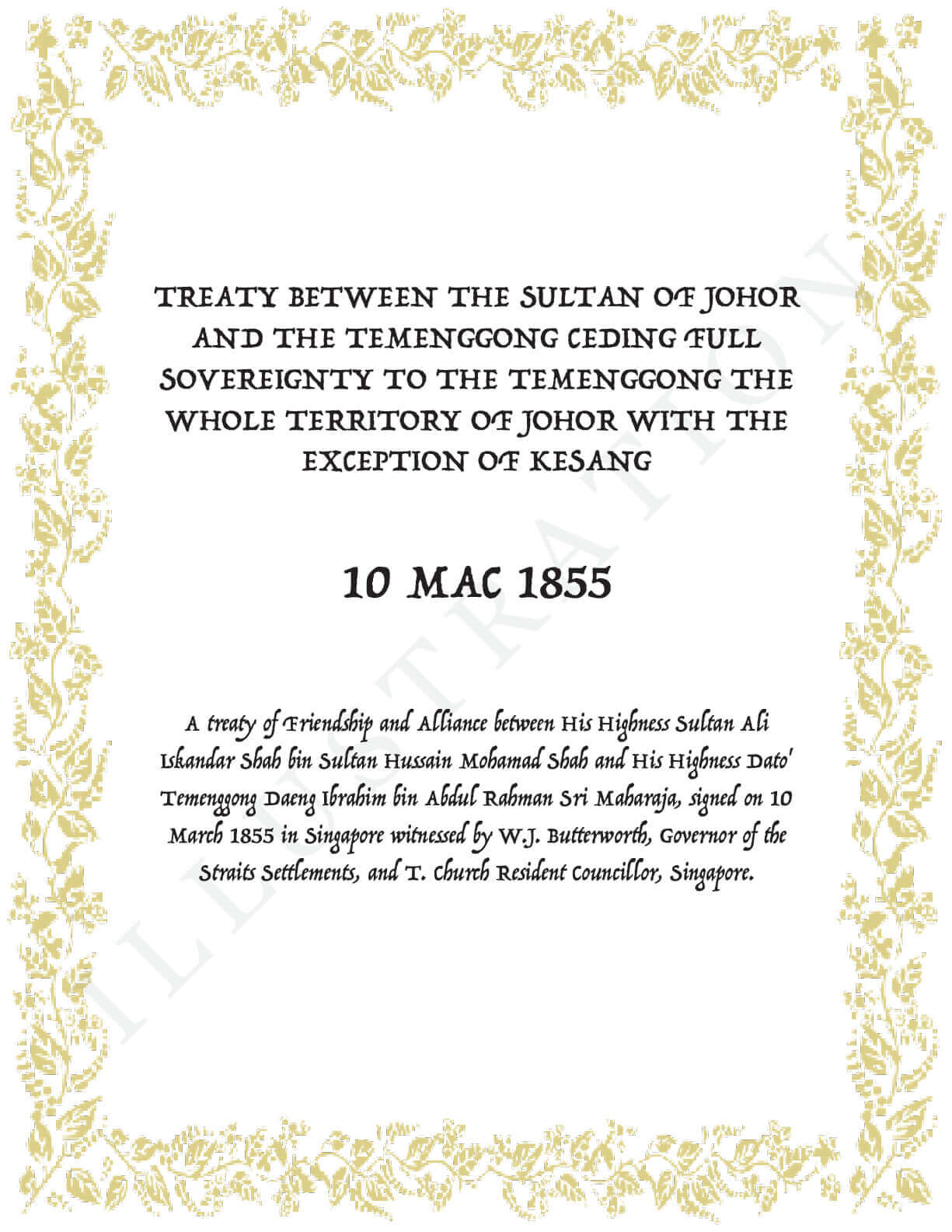
Summary of the Treaty:
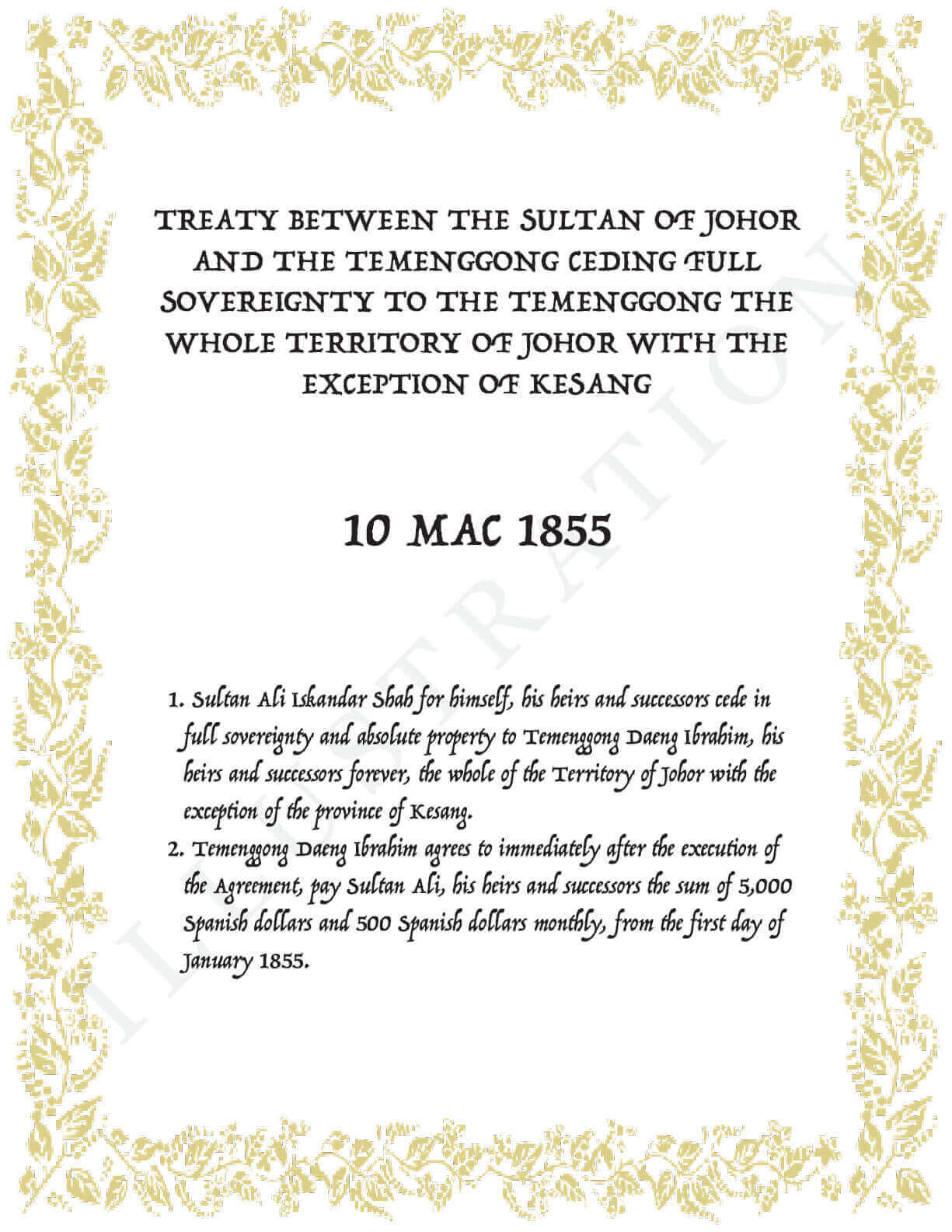
- Sultan Ali Iskandar Shah for himself, his heirs and successors cede in full sovereignty and absolute property to Temenggong Daeng Ibrahim, his heirs and successors forever, the whole of the Territory of Johor with the exception of the province of Kesang.
- Temenggong Daeng Ibrahim agrees to immediately after the execution of the Agreement, pay Sultan Ali, his heirs and successors the sum of 5,000 Spanish dollars and 500 Spanish dollars monthly, from the first day of January 1855.
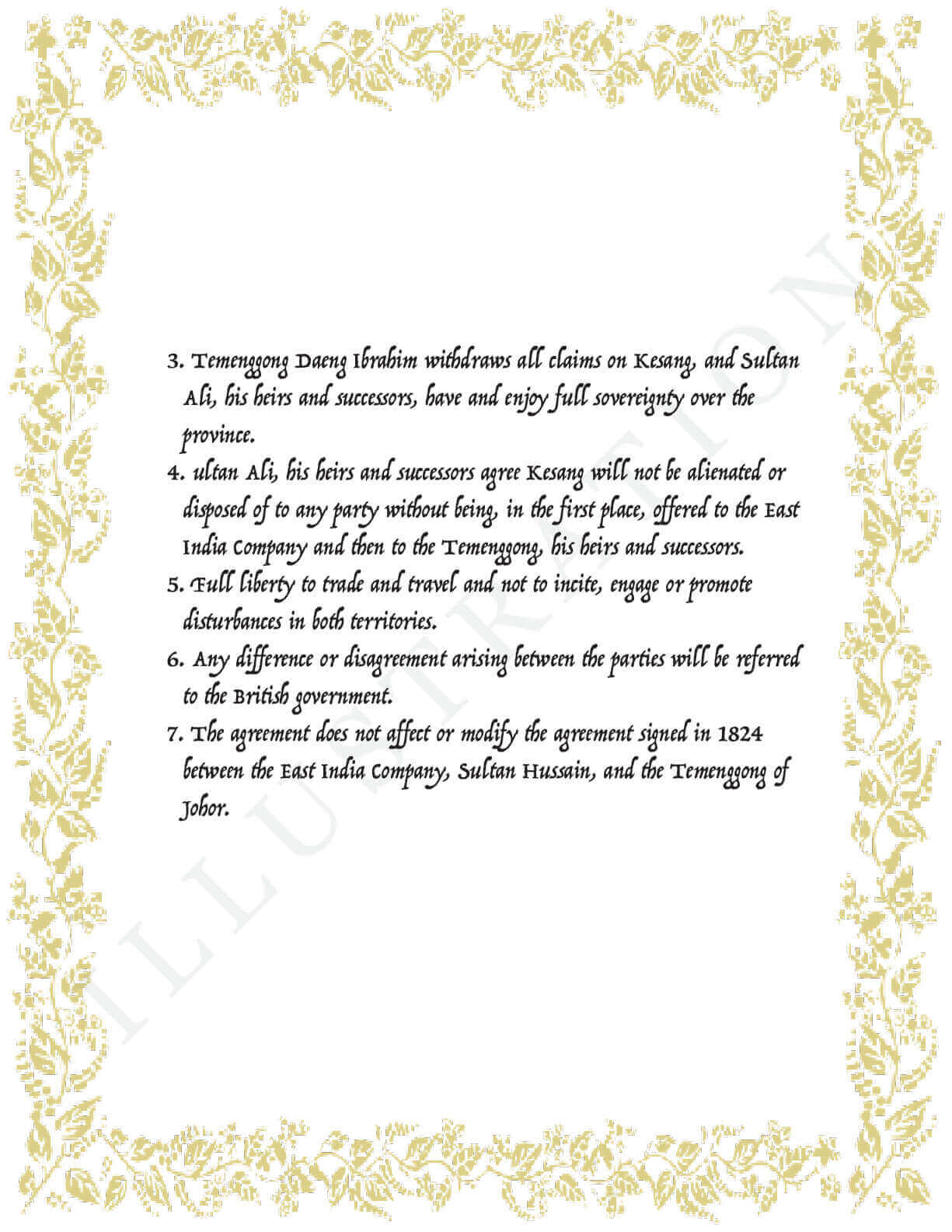
- Temenggong Daeng Ibrahim withdraws all claims on Kesang, and Sultan Ali, his heirs and successors, have and enjoy full sovereignty over the province.
- Sultan Ali, his heirs and successors agree Kesang will not be alienated or disposed of to any party without being, in the first place, offered to the East India Company and then to the Temenggong, his heirs and successors.
- Full liberty to trade and travel and not to incite, engage or promote disturbances in both territories.
- Any difference or disagreement arising between the parties will be referred to the British government.
- The agreement does not affect or modify the agreement signed in 1824 between the East India Company, Sultan Hussain, and the Temenggong of Johor.
The Cessation Of Kesang
Many negotiations were held between Tunku Alam, the heir to Sultan Ali Iskandar Shah, the British and representatives of Abu Bakar, which began on 3 September 1877 and ended on 5 February 1879. A proclamation was then made by Dato' Jaafar bin Mohamad the Menteri Besar of Johor, on 9 November 1877, and it was declared that Maharaja Abu was elected by the Temenggong and Penghulus of Muar and Kesang to be the Ruler and Raja of Kesang. This declaration was duly accepted and recognized by Queen Victoria and Britain. With the declaration, Maharaja Abu Bakar has the right and complete control over the territory of Kesang.

 English
  Malay
Malay