

When Johor gained ownership of Johor in 1855, the vast state was undeveloped and underpopulated, and it was a constraint to administer the state efficiently due to the lack of communication. So, Abu Bakar devised a state administration method by creating two divisions, each headed by his siblings as his Official Representatives. The Western Division comprising the provinces of Johor Bahru, Muar, and Batu Pahat, was headed by Ungku Abdul Majid bin Daeng Ibrahim. The Eastern Division that covered the provinces of Segamat and the eastern seaboard were under the care of Ungku Abdullah bin Daeng Ibrahim. These four original provinces are symbolised as the four stars embedded in the white shield of the state crest.
The Administrative Structure of Johor
The Administrative Structure
The Divisions
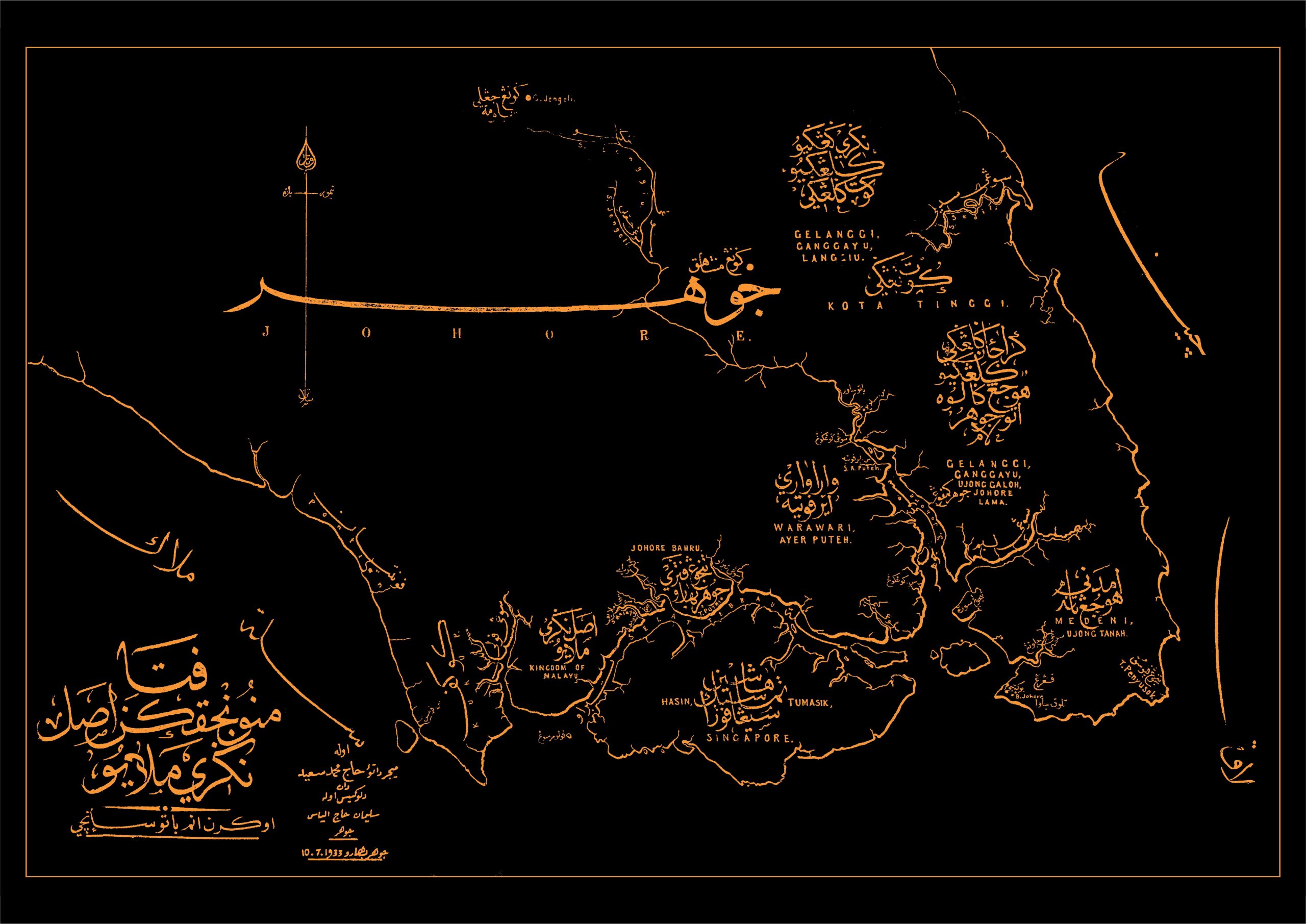
The Genggayu map shows the origin of the state of Johor by Major Dato’ Haji Muhammad Said and drawn by Sulaiman Haji Ilyas on 10 July 1933. (Source: The Royal Abu Bakar Museum)
The Residencies
This structural organization evolved into a system of Residency where the four provinces were restructured into 13 provinces, each headed by a State Commissioner. In addition, two other provinces known as Penggawa, one in the west and the other in the east, that included the islands, were created and administered by a Penggawa Barat and a Penggawa Timor, respectively. The State Commissioners and Penggawas were answerable to the Chief Commissioner in Johor Bahru.
The Districts
The evolution of the administrative organization continued after Johor accepted British rule in 1914. The thirteen residencies were changed. Eight districts were created to improve a faster and more efficient delivery system. The districts of Johor Bahru, Muar, Batu Pahat, Segamat, Kluang, Kota Tinggi, Pontian and Mersing were created.
In addition, there were five sub-districts, Kulai, Tangkak, Labis, Rengit and Penggerang. In 2008 the sub-districts of Tangkak and Kulai were elevated to full districts.
*Click The Districts for more info
Johor district boundary map
The District Officer
A District Officer appointed from among senior officers of the Johor Civil Service heads the district administration. Only Johor-born Malays with the necessary qualifications may be recruited to join this service. The District Officer is the official representative of the Ruler in all matters.
The District Officers are answerable to the State Secretary. The post of State Secretary, the principal officer in the state administration, was created in 1895 and is to be filled by a Johor-born Malay from the Johor Civil Service. Dato' Sri Amar Diraja Abdul Rahman Andak was appointed the first State Secretary.
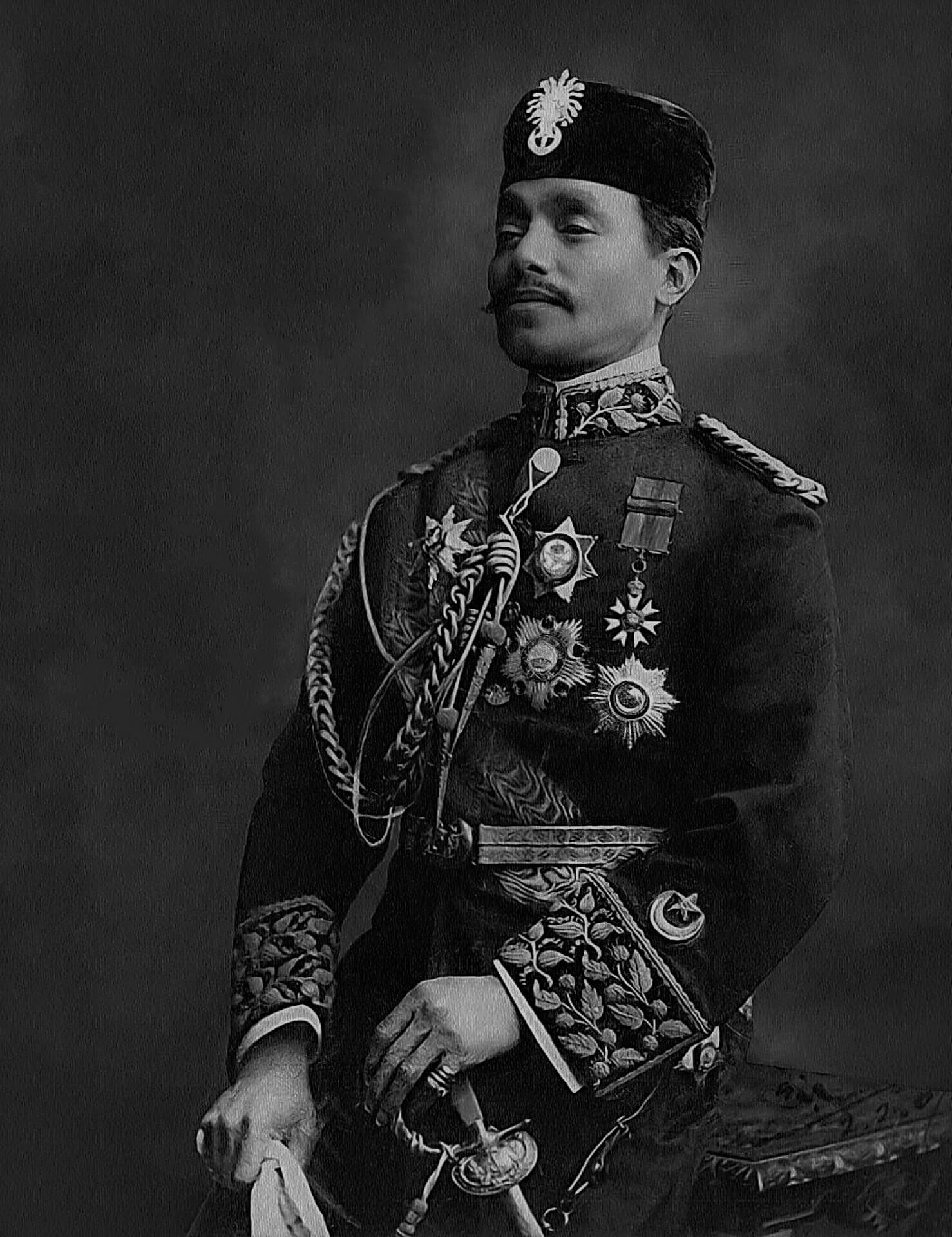
Dato’ Abdul Rahman bin Andak. (Source: The Royal Abu Bakar Museum)
The Local Authority
A system of local government was established to provide services to urban areas. The local authorities were first established as town boards. Through the years, with the increase in population and responsibilities, they evolved into district and town councils, municipalities and city councils.
*Click The Local Authority for more info
Johor Local Authority boundary map
The Penghulus
Sultan Abu Bakar was impressed with the leadership of the Javanese community. Therefore, he adopted the culture of appointing a Penghulu in each Mukim (a cluster of settlement) to provide leadership and ensure a sustainable livelihood among the people, security, as well as being a channel of information.
Only the capable among the Penghulus were elevated to Penghulu Besar and Orang Kaya status. Abu Bakar appreciated their services and honoured them by including them as members of the Supporters of the Country (Ahli Jumaah Pangkuan Negeri) under Article 1 of the First Part of the Johor State Constitution of 1895, in the matter of the selection and confirmation of the Heir as the new Ruler.
The Penghulu
Each district is divided into Mukims headed by a Penghulu. Presently there are 105 Penghulus who are answerable to the District Officer.
The Ketua Kampung
Each Mukim is further divided into Villages (Kampungs) with a Village Head (Ketua Kampong) as its leader. The 680 village heads are answerable to the Penghulus.
A Democratic Government

The administrative structure of the State of Johor in 1875. (Source: Fawzi Basri and Hasrom Haron, 1978. Modern History 1855-1940)
First Strategy
Among Abu Bakar's first strategies to stem the British forward movement was the introduction of internal reforms to the administrative machinery. Towards this end, the various government departments were restructured for efficiency and placed under the leadership of his ministers. In 1873, he established a Council of Ministers comprising 12 Malay intellectuals. The Council possessed executive authority and acted as an advisor to Abu Bakar.
In the same year, he established the State Council, comprising 34 members of the Council of Ministers and two members from the Chinese community. Which included, Mejor Cina Dato' Tan Hiok Nee, the Kangcu of Kangkar Tebrau, and Kapitan Cina Seah Theng Hye, the Kangcu of Skudai, to ensure the Chinese community was not marginalized. The establishment of the Councils marked the beginning of a democratic government.
Council Of Ministers And The State Council
The Council of Ministers and the State Council became a forum where the members could discuss freely and enacted rules and regulations without outside interference. Many of the Council of Ministers members were his contemporaries at Keasbery College. Abu Bakar honoured the members for their contribution, dedication and loyalty by conferring upon them the ascribed honorific title of Dato', as in Dato' Menteri Besar Jaafar bin Mohamad, Dato' Bentara Luar Mohamad Saleh bin Perang, Dato' Bentara Dalam Ibrahim Abdullah Munshi.
The Council of Ministers was serviced and assisted by a State Secretariat comprising Malay officers of high calibre under the leadership of the State Secretary. In 1895 Dato' Sri Amar Diraja Abdul Rahman Andak, who was sent by Abu Bakar for further education in London, was appointed the first State Secretary.
Second Strategy
Abu Bakar's second strategy was the establishment of the Johor Advisory Board in London in 1885. The Board, comprised of retired top and influential British civil servants, was an indirect conduit whereby Abu Bakar was able to obtain views and advice on the colonial policies and plan for counter strategies.
Even though Johor accepted British interference in its administration in 1914, Sultan Ibrahim was steadfast in defending its independence and was adamant in preserving ownership of Johor. Vested with authority in the appointment of Menteri Besar and the Executive Council, he insisted that the post of the British administrator be termed as General Advisor and not British Resident Advisor as in other states. He further commanded the British officers to put on the Johor tunic for official functions, the Union Jack to be flown only at the residence of the General Advisor, Malay officers to be accorded similar treatment as British officers, the Johor Military Forces to remain, the Malay as the official language, and the Jawi script be used for all official correspondence between the palace and the government.
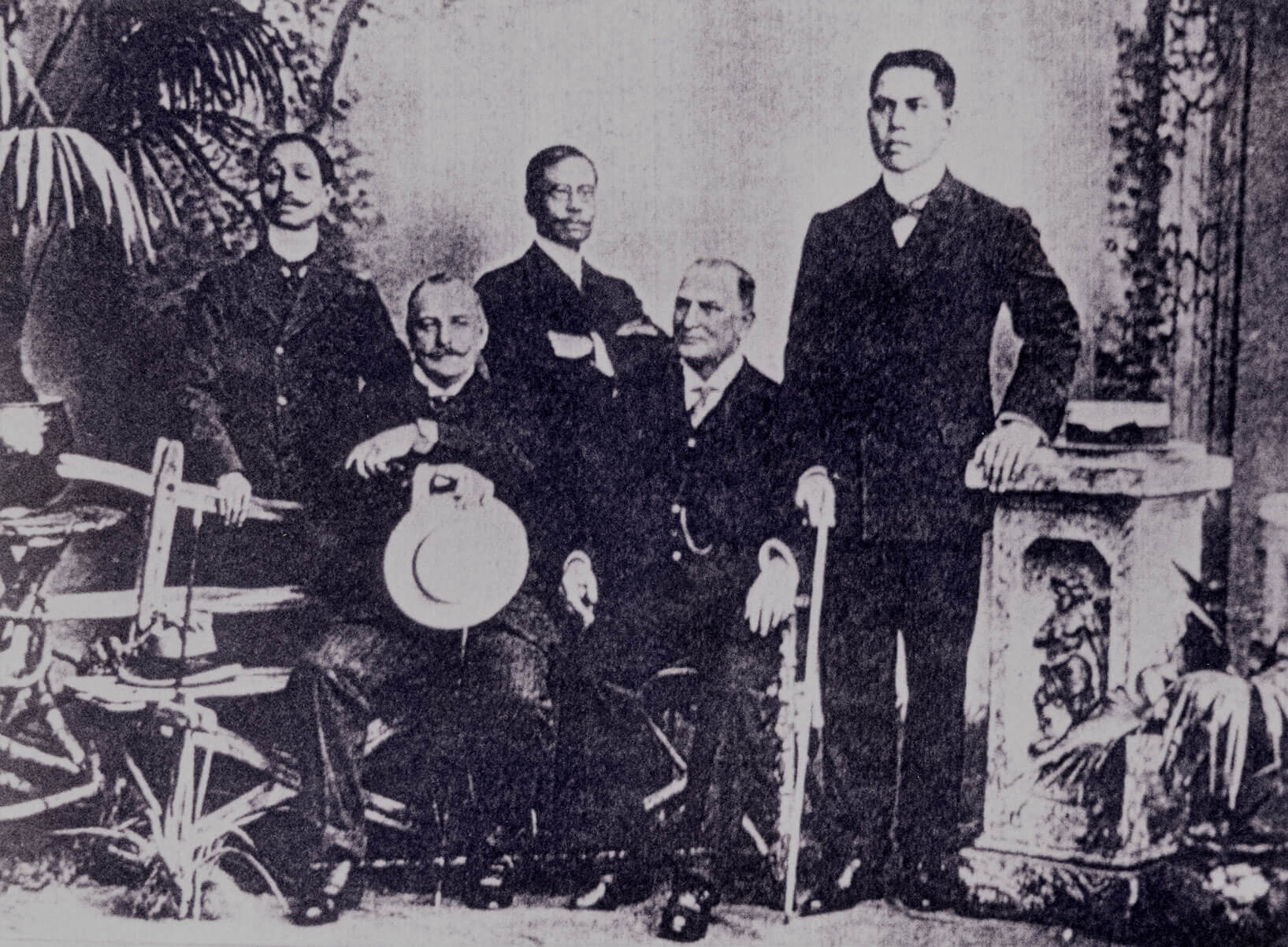
Standing from left, Dato' Sri Amar DiRaja Dato' Abdul Rahman Andak, Dato' Mohamed bin Mahbob, Sultan Ibrahim Ibni Almarhum Sultan Abu Bakar with two members of the Johor Advisory Board. (Source: National Archives Malaysia)
The Johor State Constitution
The democratic system of government was enhanced with the Johor State Constitution proclaimed on 14 April 1885. The Constitution based on Islamic family laws and feudal codes and regulations legitimized the appointment of the ruler, the mechanics of succession to the throne, the empowerment of authority to the ruler and the state's administration. Johor was the first state in Malaya to have an official and written constitution. It was initiated by the Council of Ministers, drafted in Malay in the Jawi script, and later translated into English.
Abu Bakar's primary objective of the constitution is to ensure and preserve ownership of the throne, and the state of Johor remains forever in the hands of his heirs and successors. Secondly, he envisioned the constitution as a defence of the sovereignty and independence of Johor. This is in line with Articles 15 and 16 of the Constitution, which forbid the ruler, the Council of Ministers, or any of its members from alienating or ceding Johor or any part of Johor to any foreign power. As a result, Abu Bakar was able to protect the sovereignty and independence of Johor for 33 consecutive years.

Cover of the copy of Constitution of the Government of Johor 1895. (Source: National Archives Malaysia)

 English
  Malay
Malay